
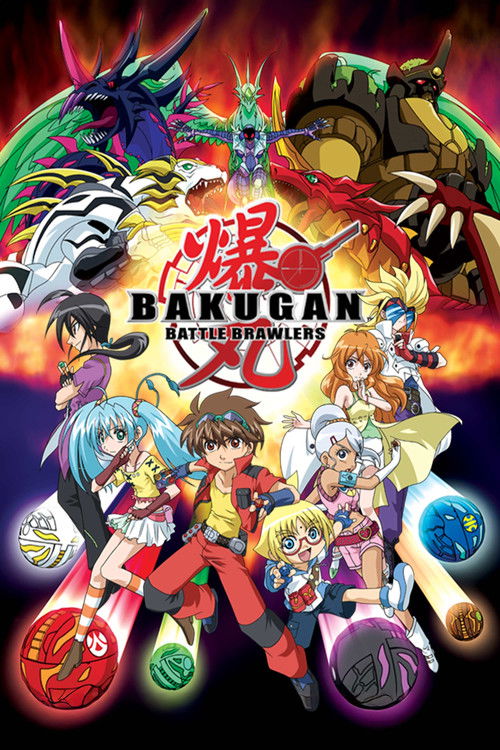
Who would have thought that small balls that turn into giant monsters would create a global phenomenon? Bakugan Battle Brawlers is the cartoon that made kids in the 2000s crazy about both cards and toys, even leading to serious tournaments. But nearly 20 years later, is this series still fun and memorable for those who grew up in that era? The editorial team takes you back in time with the Battle Brawlers and analyzes what makes Bakugan more than just a typical kids' cartoon.
Story Summary (No Spoilers)
The story begins when one day, strange cards fall from the sky all over the world, and from those cards, various shaped monsters emerge. In their normal state, they are in the form of small balls called 'Bakugan.' Kids worldwide get excited and start collecting cards and Bakugan balls to compete. A group of six kids who call themselves the 'Battle Brawlers' lead the way: Dan, Marucho, Shun, Runo, Julie, and Alice. They must learn to control the power of Bakugan and work together to fight enemies threatening Earth and other dimensions.
This series blends fantasy and science seamlessly. The world of Bakugan connects to other dimensions through dimensional gates, leading to adventures across worlds and time. The story moves quickly, with both dramatic and comedic moments. But what stands out is the emphasis on friendship and courage as the kids face huge obstacles. Without spoiling the ending, it's safe to say the Battle Brawlers' journey is full of life lessons hidden in a kids' cartoon.
Performance and Characters
Although it's an anime voiced by professional voice actors, Bakugan stands out with its unique character designs and clear personalities. Dan (Danma Kuso) is a hot-headed, determined hero who loves to fight. His partner Drago (Dorago), a dragon, is a charming and loyal Bakugan. Marucho represents the smart, tech-savvy kid. Shun is the quiet, skilled, and gifted one. Runo and Julie are strong, multi-dimensional female characters, not just sidekicks.
All voice actors perform excellently, especially Yu Kobayashi who voices Dan with both bravado and vulnerability, while the late Keiji Fujiwara gives Drago a warm and imposing voice. The Thai dub aired on Channel 9 is also fondly remembered by Thai kids of that era. Although the series doesn't focus on deep emotional expression like adult anime, it's enough to make viewers bond with the characters and root for them in every battle.
Direction, Visuals, and Music
In 2007, Bakugan's visuals were considered beautiful and smooth for an action-oriented cartoon. Each Bakugan design is unique in shape and power. The transformation from ball to giant monster is seamless and exciting. Battle scenes are full of color and light effects that attract kids. The Japanese opening theme 'Bakugan Theme' and ending 'Bakugan 2nd Theme' are catchy and memorable. The Thai versions re-sung by Thai artists were also popular.
The series was directed by Mitsuo Hashimoto (director of 'Dragon Ball Z'), giving the story a good pace without dragging. However, some episodes focus too much on exposition for kids who just want action. Overall, the technical aspects are well done by 2000s anime standards and remain enjoyable today, even if the graphics are no longer cutting-edge.
Editorial Analysis
Bakugan is more than a kids' cartoon because it clearly reflects the collecting and competitive culture of 2000s kids. The series not only created a toy and card game craze but also taught friendship, courage, and acceptance of differences through characters of various ethnicities and personalities. However, looking back, the story can be repetitive at times, especially battles that often end with narrow victories for the heroes, and the return of old enemies makes one question creativity.
The strength that sets Bakugan apart from other battle anime is its blend of the real world and fantasy through dimensional gates, allowing for diverse adventures. The fact that Bakugan can communicate with humans creates deep bonds between kids and their monsters. Even though there are many similar anime today, Bakugan remains a legend that 2000s kids won't forget. For those who didn't grow up with it, watching the series today may evoke nostalgia and provide mindless fun.
Verdict
Bakugan Battle Brawlers is a cartoon that created fond memories for 2000s kids with its fun content, cute characters, and exciting action. Although the graphics are a bit dated, it's still enjoyable to watch today. It's perfect for those who want to relive their childhood or introduce a new generation to a legendary piece of kids' anime.
Screenshots


👍 Pros
- +Fun, exciting story suitable for kids
- +Unique characters with clear development
- +Excellent toy and card game craze
- +Catchy and memorable soundtrack
👎 Cons
- −Some story arcs are repetitive and predictable
- −Graphics look dated compared to modern anime
Top Cast




FAQ
Bakugan has 4 seasons with a total of 189 episodes (Season 1: 52 episodes, Season 2: 52 episodes, Season 3: 39 episodes, Season 4: 46 episodes).
In Thailand, Bakugan aired on Channel 9 (Channel 9 MCOT HD) during 2008-2009 and later re-aired on Cartoon Club Channel.
Bakugan focuses on battles using cards and balls that transform into monsters, while Pokémon focuses on catching and training monsters in an open world. Additionally, Bakugan has dimensions connecting the real world to fantasy worlds.
The series is suitable for children aged 6-12, but it's also enjoyable for adults who grew up with 2000s cartoons.


